Will iSEE Last? A Systems Analysis of Alex Onyia's ₦56M Education Experiment
March 11, 2026
15 min read
The Story
Alex Onyia (@winexviv), CEO of Educare, had a problem.
Children in Nigeria's South East were falling behind in STEM education. Schools lacked resources. Talented students had no support. The region's intellectual potential was being wasted.
He could have done what most well-meaning people do: donated some money to a few schools, felt good about it, moved on.
Instead, he built a system.
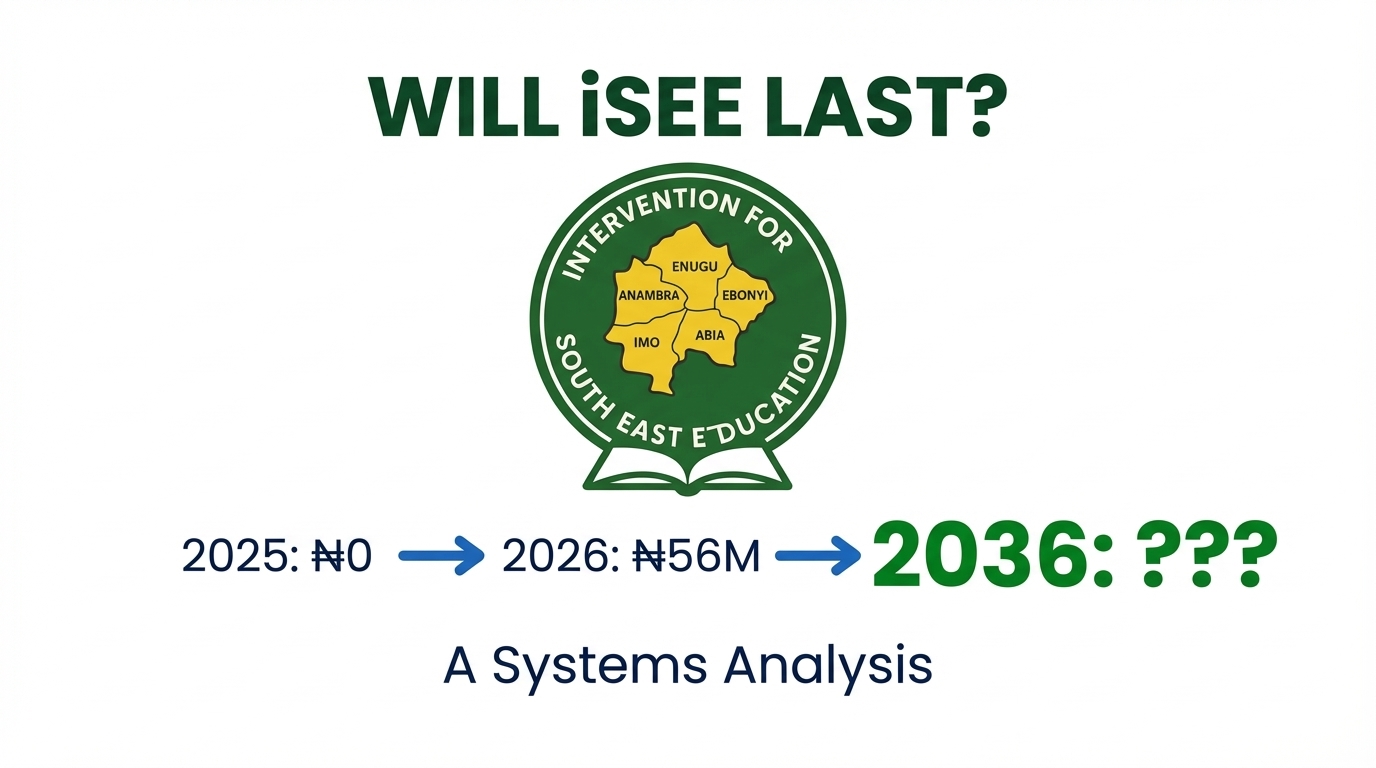
iSEE (isee.ng) has now moved ₦55.9M through its platform in transparent transactions, funded education for 236 students, and is planning the most audacious education prize structure Nigeria has ever seen.
For 2027, Alex announced:
- ₦10M for senior category winner
- ₦5M for junior category winner
- ₦3M for primary category winner
- ₦3M for each category's winning teacher
- ₦10M for each category's winning school
- ₦2M for each category's state coordinator
- ₦100K for all 45 finalists just for qualifying
- Plus second and third place prizes
- Total prize pool: ₦60M+
- Plus a £32,200 international trip to Rome for winners and teachers
His words: "We want to set everywhere on fire at a scale never seen before. South East should be the education capital for Africa."
The buzz is real. 69,100 views on that announcement. People want in. The model is spreading.
But will it last?
Let me break down what iSEE got right, what concerns me, and what would make this truly generational.
What iSEE Actually Is
Think of it as a modernized village contribution system powered by technology.
The structure:
- Anyone can join as a "Villager" (donor) at isee.ng
- Pledge monthly or one-time donations
- Get voting rights on which education projects to fund
- Track everything via public ledger — every naira in, every naira out
- Projects execute (student sponsorships, Maths Olympiad, school desks, etc.)
- Results measured (academic progress tracked, winners celebrated)
Current scale (as of March 2026):
Financial transparency (real-time public ledger):
- Total inflows: ₦55,980,875
- Total outflows: ₦54,725,350
- Cash on hand: ₦1,255,525
- Transactions logged: 396
Every single transaction visible at isee.ng/public-ledger.
Impact so far:
- 236 students sponsored (all academically progressing)
- South East Maths Olympiad across 5 states (Abia, Anambra, Ebonyi, Enugu, Imo)
- £32,200 funded for international STEM Olympiad trip to Rome
- School visits conducted across all SE states
- 1 Child - 1 Desk campaign running
- Back to School Initiative targeting 10,000 children
Major contributors include:
- @_KingNath: ₦15M
- Educare (Alex's company): ₦10M+ in top-ups
- @eldivine: ₦5M
- @Max_Sengu: ₦4M
- Plus hundreds of smaller donors
The 2027 Vision: "Set Everywhere on Fire"
| Category | 1st Place | 2nd Place | 3rd Place | Teacher Prize | School Prize | State Coordinator |
|---|---|---|---|---|---|---|
| Senior | ₦10M | ₦500K | ₦300K | ₦3M | ₦10M | ₦2M |
| Junior | ₦5M | ₦500K | ₦300K | ₦3M | ₦10M | ₦2M |
| Primary | ₦3M | ₦500K | ₦300K | ₦3M | ₦10M | ₦2M |
Plus:
- All 45 finalists: ₦100K each just for qualifying (₦4.5M total)
- International trip: £32,200 for winners + teachers to Rome
- Total 2027 budget: ₦60M+ in prizes alone
The strategy:
This isn't just about rewarding winners. It's about creating systemic incentives:
- Students: Life-changing money for excellence (₦10M can fund university + business)
- Teachers: ₦3M reward = "Develop talent, get paid" (aligns teacher incentives with student success)
- Schools: ₦10M prize = "Host/develop champions, transform your infrastructure" (creates competition among schools)
- State Coordinators: ₦2M = "Maximize participation and quality in your state" (incentivizes grassroots mobilization)
- All finalists: ₦100K = "Excellence is rewarded, not just winning" (reduces winner-take-all dynamics)
This is systems thinking applied to incentive design.
What Alex Got RIGHT (The Genius Moves)
1. He Built on Proven Village Economics
iSEE isn't a novel concept. It's based on traditional Igbo community contribution systems (isusu, village development unions) that have worked for generations.
Alex just added:
- Technology (easier to contribute via isee.ng)
- Transparency (public ledger with 396 transactions logged)
- Scale (entire SE region, not one village)
He didn't invent a new behavior. He amplified an existing one. Igbo communities already contribute collectively for funerals, weddings, village infrastructure. iSEE just channels that behavior toward education.
Lesson: Don't fight culture. Build on it.
2. Radical Transparency (Every Naira Tracked)
Public ledger at isee.ng/public-ledger shows all 396 transactions, updated in real-time. You can literally watch money move in and out.
Most charities fail because of trust issues. People don't know where money goes. iSEE eliminates that question. No opacity. No ambiguity. Result: Donors keep giving because they see exactly what happens with their money.
3. Voting Rights = Ownership
Only donors get to vote on projects. Want to influence what gets funded? Contribute.
By giving donors voting power, Alex turned them from "people who gave money once" into stakeholders with ongoing interest. This creates self-reinforcing loops:
Donate → Get voting rights → Vote on projects → See your choice implemented → Feel ownership → Donate more
4. He Made Education Exciting (Not Just "Important")
The problem with most education initiatives: they guilt-trip people. Guilt works once. Then people tune out.
iSEE made education aspirational and competitive. A primary school student can win ₦3M + their teacher gets ₦3M + their school gets ₦10M. That's ₦16M total impact from one student excelling.
- Message to students: Excellence in math = generational wealth
- Message to teachers: Develop talent = serious money
- Message to schools: Produce champions = transform your infrastructure
This isn't charity. It's opportunity on steroids.
5. Systemic Incentive Alignment
Traditional model: Student wins → Student gets small prize. Teacher gets nothing. School gets nothing. Result: Lukewarm participation.
iSEE model: Student wins → Student gets ₦10M. Teacher gets ₦3M. School gets ₦10M. Coordinator gets ₦2M. Result: Everyone is incentivized to make students succeed.
This is how you create system-wide excellence.
6. Free Participation (No Barriers to Entry)
The Olympiad is free for all SE children. No registration fees. No exam fees. No "pay to play."
Most talent competitions exclude the poor (who often have the most raw talent, least opportunity). iSEE says: "If you're brilliant but broke, we still want you." This maximizes the talent pool and ensures they're finding the actual best students.
7. Proof Before Scale
Alex tested this model at the village level first, made sure it worked, then scaled to the region. He didn't start with "I'm going to fund education for 5 states." He started with: "Can I make this work in one village?"
Most people skip the pilot. They launch big, fail big, give up. Alex built proof first (₦55.9M successfully moved). Now he's scaling what works.
What Concerns Me (The Sustainability Risks)
Current financial reality:
- Cash on hand: ₦1,255,525
- 2027 planned spend: ₦60M+ (just in prizes)
- Plus operational costs + £32,200 international trip + 236 ongoing student sponsorships
- Gap: Massive.
Risk 1: Founder Dependency (Single Point of Failure)
iSEE is fundamentally Alex Onyia. He's the public face, the major funder, the strategic decision-maker. All major announcements come from his account. Major funding injections come from him and his company.
What happens if Alex gets tired? Shifts focus? Becomes unavailable?
Does iSEE survive without him? Current answer: Probably not.
What's missing: Distributed leadership — a board with real authority, other public champions, succession planning, systems that run independent of any one person.
Test: If Alex disappeared tomorrow, would iSEE continue operating smoothly for 12 months? If the answer is "probably not," that's a structural fragility.
Risk 2: The ₦60M Question (Where Will It Come From?)
2027 budget reality check:
- Prizes: ₦60M+
- International trip: £32,200 (~₦60M at current rates)
- Operations + ongoing sponsorships: ₦X million
- Total: ₦120M-150M+ needed
- Cash on hand: ₦1,255,525
To raise ₦120M-150M requires either a massive donor surge, a few mega-donors (concentration risk), or Alex funding the gap (makes system dependent on one person's wealth).
What's missing: Diversified, predictable revenue streams.
Risk 3: Prize Inflation Creates Expectations
2027 sees ₦60M+ in prizes. What happens in 2028? Do prizes need to be ₦80M to maintain excitement?
Once you establish a prize level, it's hard to go backwards without disappointing stakeholders. This creates a ratchet effect: expectations only go up, never down.
What's needed: A sustainable prize structure backed by an endowment, not annual fundraising.
Risk 4: State Coordinator Prize Controversy
One concern raised publicly: "These state coordinators are not the direct teachers so this amount (₦2M) is very high for them if not they will start fighting for who will be posted as a coordinator and bribing their way in."
If state coordinator positions come with ₦2M prizes (up to ₦6M total per state if all three categories win), that creates rent-seeking incentives. People will want to become coordinators not to serve, but to capture prizes.
What's needed: Clear, performance-based criteria for coordinator rewards — or restructured as operational funding with transparent accounting.
Risk 5: School Prize May Not Benefit Students
Another concern: "The amount for schools (₦10M) is extremely high because these pupils/students pay higher school fees, so what would the schools be doing with this money EXCEPT if they will cut down on their tuition fees."
₦10M given to a school with no conditions = school owners might pocket it, especially private schools charging high fees.
What's needed: Conditional school prizes — require a spending plan, public accountability for how the ₦10M is used, and proof of student benefit.
Risk 6: No Clear Path to Financial Independence
Current model: Perpetual fundraising. Every year: raise ₦120M-150M+, rely on donations + Alex's injections, no revenue diversification.
What happens in Year 10? Will donors still be excited? Will Alex still be injecting funds?
Three viable paths to financial independence:
Path 1: Endowment Model (Recommended) Raise ₦1B-2B once, invest it, live off returns forever.
- ₦2B at 15% return = ₦300M/year → Never fundraise again
Path 2: Government Partnership Get SE state governments to co-fund as official regional program.
- 5 states × ₦20M each = ₦100M/year (government funding)
Path 3: Earned Revenue License the iSEE model to other regions, create paid STEM prep courses, or run corporate STEM CSR programs for a management fee.
Risk 7: Lacks Self-Reinforcing Economic Loops
Current model: Donors give → Students get sponsored → Students succeed → ??? → System continues.
What's missing: A loop where success feeds back into the system economically.
Consider: every student sponsored signs a pledge — "When I'm financially stable (earning ₦200K+/month), I'll contribute 2% of my income back to iSEE for 10 years."
- 236 students sponsored so far
- If 50% eventually earn ₦200K+/month → 118 alumni × ₦4K/month = ₦472K/month
- Year 10: ₦590K/month from alumni
- Year 20: ₦3M/month from alumni
Eventually, alumni giving funds new student sponsorships without external donations. This loop doesn't exist yet.
The Six Sustainability Principles: How iSEE Scores
(Using the framework from my What Makes a System Sustainable? essay)
| Principle | Score | Status |
|---|---|---|
| Resource Balance | 4/10 | ⚠️ Positive lifetime, but 2027 gap is massive |
| Self-Reinforcing Loops | 5/10 | ⚠️ Viral loops work; economic loops missing |
| Distributed Resilience | 2/10 | ❌ Critically founder-dependent |
| Adaptive Capacity | 8/10 | ✅ Highly responsive, iterates well |
| Aligned Incentives | 7/10 | ✅ Strong, but coordinator/school prizes need refinement |
| Regeneration Over Extraction | 10/10 | ✅ Perfectly regenerative mission |
Overall: 6.0/10
Strengths: Regenerative mission, adaptive capacity, aligned incentives.
Critical weaknesses: Distributed resilience, resource balance, self-reinforcing economic loops.
Verdict: Beautiful vision and strong execution. But structurally fragile. The system works because Alex makes it work. For it to last 50 years, it needs to work even when Alex doesn't.
What Would Make This Truly Generational
Phase 1: Stabilize Revenue (2026–2027)
Launch a "₦2B Forever Fund" Campaign
"Our goal: Raise ₦2 billion so the South East Maths Olympiad runs forever, without asking for another donation. Will you help us get there?"
Target: SE diaspora professionals, Nigerian billionaires with SE roots, international education foundations.
Pursue corporate sponsorships — banks, telcos, FMCGs — with tiered packages:
- Platinum (₦50M): Title sponsor ("MTN South East Maths Olympiad")
- Gold (₦20M): Category sponsor ("GTBank Primary Category")
- Silver (₦10M): State sponsor ("Airtel Anambra State Championship")
Pitch SE governors formally: "iSEE is putting SE on the international map. Each state contributes ₦20M annually — tiny vs your ₦200B+ budgets — and you get political credit for transforming education."
If all three succeed: ₦200M-660M in Year 1 of the endowment campaign. Enough for 2027 + start building toward permanence.
Phase 2: Distribute Leadership (2027–2028)
-
Form Real Board of Trustees — 7 members including Alex (Chair), major donors, education experts, finance and legal experts — with real authority over budget, strategy, and executive appointments.
-
Hire an Executive Director — full-time operational leadership reporting to the board, not just Alex. Alex shifts to strategist; ED handles day-to-day.
-
Recruit public champions — 5-10 other prominent SE figures as ambassadors and fundraisers. If Alex steps back, others carry the message.
-
Document everything — operational manuals for the Olympiad, donor onboarding, student sponsorship criteria, financial management, coordinator selection. Knowledge transfer = continuity.
Phase 3: Build Economic Loops (2028–2030)
-
iSEE Alumni Giving Program — every student sponsored signs a pledge to give 2% of income back when earning ₦200K+/month. Public Alumni Honor Roll. Annual tracking.
-
Hit ₦1B Endowment Milestone — ₦1B at 15% = ₦150M/year. Enough to cover the Olympiad, operations, and student sponsorships. Reduces donation dependency by 50%.
-
Franchise to one other region — pilot the iSEE model in South West Nigeria. Charge 10% fee for platform/support. Proves replicability and adds revenue.
Phase 4: Institutionalize (2030–2035)
-
Build a physical iSEE Education Center in SE — office, STEM lab, training center, library. Physical presence signals permanence.
-
Hit ₦2B Endowment — ₦2B at 15% = ₦300M/year. Never need to fundraise again.
-
University partnerships — formal MOUs with University of Nigeria Nsukka, Nnamdi Azikiwe, others. iSEE scholars get priority consideration. Institutional backing.
-
International recognition — UNESCO, UNICEF, Mastercard Foundation, Gates Foundation partnerships. Global credibility attracts more funding and enables scaling across Africa.
What Success Looks Like in 10 Years (2036)
Financial:
- ₦2B+ endowment generating ₦300M+/year
- Zero dependency on donations (self-sustaining)
- Franchised to 5+ other Nigerian regions + 3 African countries
- ₦50M+/year in franchise fees
Impact:
- 2,000+ students sponsored (10-year total)
- 10 Olympiad cycles completed
- SE recognized as Africa's education capital
- Alumni giving back (₦2M-3M/month from 200+ alumni)
Structure:
- Professional board governing
- Executive Director running operations
- 50+ staff across 5 states
- Physical iSEE Education Center operational
Resilience:
- System runs independently of Alex (board chair emeritus, not operator)
- Multiple revenue streams (endowment 60%, government 20%, corporate 10%, alumni 10%)
- Distributed leadership (20+ public champions)
At this point: iSEE is an institution, not a project. It will outlive Alex. It will outlive current donors. It will last 100+ years.
Final Thought
Alex Onyia has built something rare and beautiful.
What he got right:
- ✅ Transparent (₦55.9M tracked publicly across 396 transactions)
- ✅ Community-owned (918 donors with voting rights)
- ✅ Culturally grounded (built on Igbo contribution traditions)
- ✅ Impact-driven (236 students progressing academically)
- ✅ Aspirational (₦60M+ prize pool that "sets everywhere on fire")
- ✅ Adaptive (iterates based on feedback, scales what works)
- ✅ Regenerative (builds human capital, celebrates excellence)
This is world-class systems thinking applied to social impact.
But beautiful isn't enough to last 50 years.
The risks:
- ❌ Founder-dependent (remove Alex → system likely collapses)
- ❌ Revenue fragility (₦120M-150M gap for 2027, unclear funding)
- ❌ No economic loops (success doesn't feed back financially)
- ❌ Prize inflation (expectations ratchet up, hard to sustain)
- ❌ Potential rent-seeking (coordinator/school prizes need conditions)
These aren't criticisms. They're design challenges. And they're all fixable.
The path forward:
- Phase 1 (2026-2027): Stabilize revenue (endowment campaign, corporate sponsors, government partnership)
- Phase 2 (2027-2028): Distribute leadership (board, Executive Director, documented processes)
- Phase 3 (2028-2030): Build economic loops (alumni giving, endowment compounding, franchising)
- Phase 4 (2030-2035): Institutionalize (physical center, university partnerships, international recognition)
Result: Transform from "Alex's incredible project" to "Southeast Nigeria's permanent education infrastructure."
Alex has built the heart. Now he needs to build the skeleton — the structure that ensures this outlasts any one person.
The vision deserves to last 100 years. With the right structural improvements, it can.
To Alex and the iSEE community: you've proven the model works (₦55.9M moved transparently). You've created massive excitement (69K+ views, viral momentum). You've changed lives (236 students and counting). Now build it to last. Because the South East — and Africa — needs this to be permanent, not temporary.
Henry
Systems Architect. Builder. Thinker.
P.S. — If you're inspired by iSEE: donate at isee.ng (100% transparent, see exactly where your money goes). And if you're building something similar — community-funded education, tech-enabled charity, social impact initiative — the principles here apply to you too.
For systems builders
Do you see broken systems
and feel the pull to fix them?
I write about systems thinking, building things that balance people and profit, and the courage it takes to create something new. If that's you — join the list.
Founders, engineers, and leaders who are building better systems.
SubscribeReady to Redesign Your System?
If you've identified a broken system and want help fixing it properly, let's talk.
Start a Conversation