The Igbo Awakening - How I Went From Not Thinking About Being Igbo to Thinking About It Every Day
March 22, 2026
8 min read
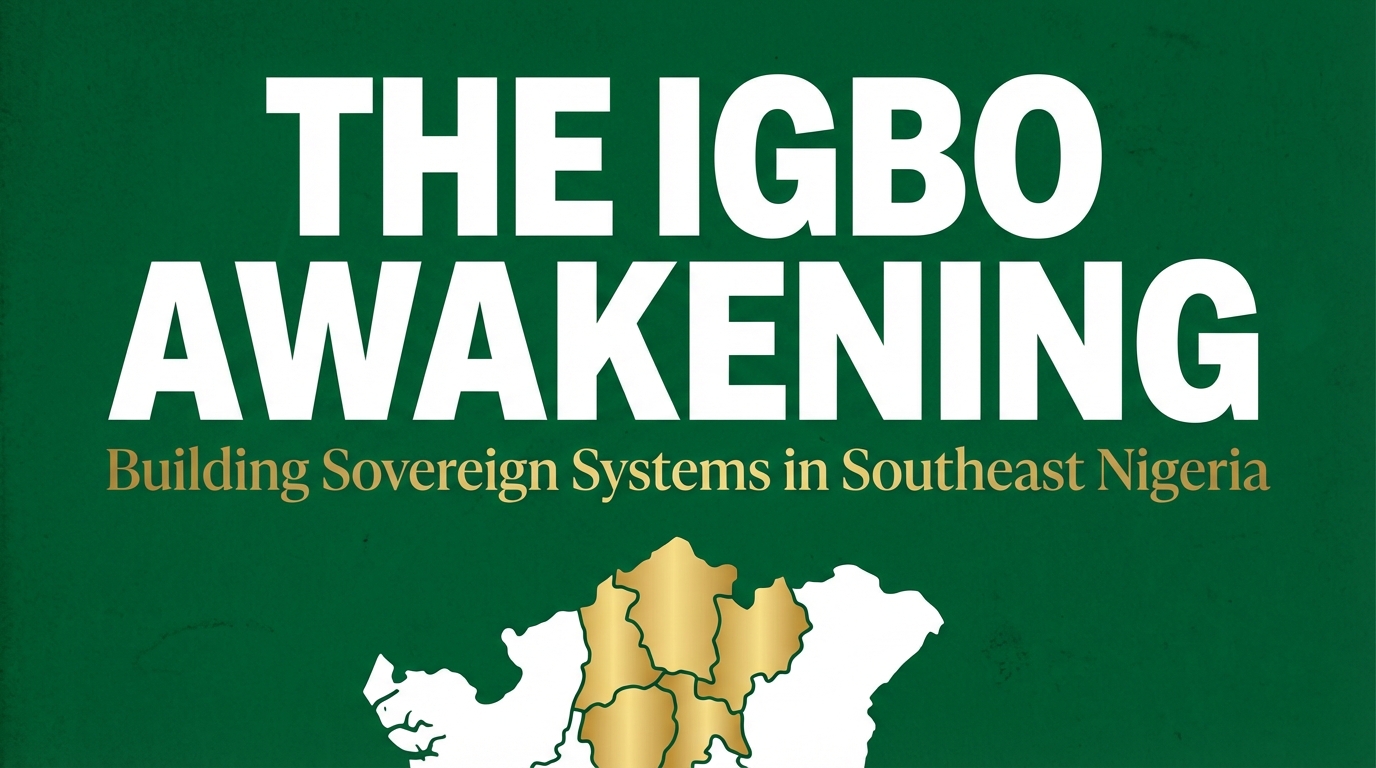
I was 28 years old. And for the first time in my life, I realized that being Igbo was perceived as a problem.
Let me give you context.
Growing Up
I grew up in the city of Port Harcourt, Rivers State, Nigeria, and I am from Abia State, which is a 1-2 hour drive from Rivers State. We went to the village every Christmas and Easter. My granddad fought in the Biafran War, yet I lived a largely normal life. I was never self-conscious about being Igbo. I never saw it as a problem.
All this changed when I moved to Lagos.
Moving to Lagos (2018)
After uni, I decided to move to Lagos in 2018. This was my first time living in any major city in Nigeria besides Port Harcourt and Abia.
It started small—"omo Ibo" here and there. I dated Yoruba girls that told me their parents don't like Igbo people. When I wanted to rent an apartment, the landlord made it a point to mention that she doesn't like Igbo tenants.
In all this, I didn't say much. I just paid attention.
Don't get me wrong, it wasn't so bad that anyone with a stable sense of self can't manage. But something fundamental happened in 2023.
The Awakening (2023 Elections)
All my life, it's never come to my mind that an Igbo man hasn't been a democratically elected president of Nigeria—even when there is a clear rotation happening across regions.
But in 2023, a man named Peter Obi, an Igbo man, decided to run for presidency. And that was where, for me personally, the veil was unveiled.
You see, I was living in Mushin, Lagos. I dey getto, in the thick of it all, so I got to see so many people switch up during election period. And for the first time in my life, it felt like being Igbo was perceived to be a problem.
I heard grown men and women and young boys and girls saying all sorts of things about my tribe—from "an Igbo man can never be president of Nigeria" to "Igbo people will enter power and dominate everyone."
I mean, this was all fairly new to me, but the signs were always there.
Which made me ask: why?
The System I Started Seeing
As someone who thinks in systems, I started seeing patterns:
- The media is largely controlled by one region
- The narrative about Igbo people has been consistent for decades
- My granddad fought in the war, yet I never heard him speak ill of any tribe
- But in Lagos, anti-Igbo sentiment is normalized
This isn't random. This is a system. A system designed to keep certain people in power and certain people out.
How the System Works
Here's what I realized:
The Southwest and the North both share in anti-Igbo propaganda. And it's not accidental.
You see, the West largely controls media. And the North controls federal power. And for decades, they've been fed—and feeding—propaganda about Igbo people.
But I didn't fully understand the design until 2023.
During the campaign, the current president (a Southwesterner, APC) didn't have to directly attack Peter Obi. His supporters did it for him. And those supporters? Largely APC members—a party that bridges Southwest and North.
That's when it clicked for me.
The system is designed to create Southwest-North alignment. A rotation between them. Yes, power has gone to the South-South before, but look at the pattern: North → South-South → North → Southwest → North.
Notice what's missing? The Southeast.
The only geopolitical zone that has never produced a democratically elected president.
And it's by design.
Why It Works
The propaganda serves a purpose: fear.
- Tell the Southwest: "If Igbo people get power, they'll dominate you economically"
- Tell the North: "If Igbo people get power, they'll undermine your political structure"
- Result: Both regions align against the Southeast
And the rotation continues. North → Southwest → South-South → North → Southwest.
Southeast? Never in the equation.
They might just be better long-term system builders than us.
They built a system that keeps them in power through fear and alignment. A system where even when Igbo people win elections (like Peter Obi winning Lagos), the structure overrides the outcome.
What Happened
Peter Obi ended up contesting the elections and even winning in Lagos—despite all the blatant bigotry throughout the elections.
People were beaten up and prevented from voting just for looking Igbo.
The elections were eventually rigged on a national level and the current president was declared winner.
But at what cost?
The entire country and anyone with two eyes saw what happened in 2023.
But the system worked exactly as designed.
The Awakening
After 2023, the Igbo youths began a lot of introspection:
- Are we even welcome in this country?
- Was Nigeria designed for Igbo to be oppressed?
- Is separation not a better option?
These were thoughts that were not really in the mainstream consciousness of Igbo youths. It definitely wasn't something I thought about.
But after 2023, I think about it every day.
And I know I'm not alone.
What This Means for Us
This realization changed everything for me.
Because if they've built a system to keep us out, we need to build a system to opt out.
Not just to win elections—to develop our region.
You see, this generation of Igbo youth needs to understand something fundamental:
We're not building systems to win Nigerian elections. We're building systems to develop the Southeast.
And if elections happen as a byproduct of our development? Great.
But if they don't? We're prepared to exit the country.
Because at the end of the day, we don't need their permission to build.
What We Must Do
It's more important now, more than ever, for us to build our region and put more sovereign power within ourselves.
There is much work to be done, and I know a lot of Igbo—both home and abroad—feel this same urge.
It's funny because before 2023, I never thought I would ever want to live in my village. But after that election, I'm so glad we have a lot of land in the village.
But there is much to be done.
We are the new generation of Igbo leaders, and we need to play our part to ensure we build a resilient region.
We need to be heavy investing in:
- Economic sovereignty: Trade among ourselves first. Build Igbo-to-Igbo commerce before looking outward.
- Energy independence: Solve power in the Southeast. We can't build industries without stable electricity.
- Infrastructure: Intra-state train lines connecting Aba, Enugu, Owerri, Onitsha. Roads that actually work. Ports that function.
- Education: Programs like iSEE (Igbo-medium math education) that preserve our language while building excellence. We must invest heavily in our children.
- Technology: Build our own platforms. Stop depending on others to tell our stories or control our narrative.
- Media: Counter the bigotry narrative with our own voices. Loudly. Consistently.
- Cultural preservation: Our language, our traditions, our identity. These are not optional—they are foundational.
We build our region so strong that whether we're in Nigeria or not, we thrive.
That's the system we're building now.
We need to really sit up, and there are a lot of young men already taking initiative to create platforms and systems to ensure the development of our region.
The Awakening I'm Seeing
I also see and notice a lot of Igbo accounts on social media are now more active in countering the bigotry narrative.
This is great.
We must ensure we create very strong defenses—and also offensives.
I personally don't think we're competing with anyone. We know we are not where we need to be. We need more alliances and more trade, and it's all possible.
Nothing is stopping us.
Final Thought
I love you all, my Igbo people.
And I love that we are now awakening to our strengths and power, and we must use it to develop our capabilities and excel in all things we do—not to oppress anyone, but because excellence is our culture.
As we always do.
We build our region so strong that whether we're in Nigeria or not, we thrive.
The system they built was designed to keep us out.
The system we're building is designed to make that irrelevant.
Ndewo.
For systems builders
Do you see broken systems
and feel the pull to fix them?
I write about systems thinking, building things that balance people and profit, and the courage it takes to create something new. If that's you — join the list.
Founders, engineers, and leaders who are building better systems.
SubscribeReady to Redesign Your System?
If you've identified a broken system and want help fixing it properly, let's talk.
Start a Conversation